Would you know where to place the pads when using a defibrillator to save someone’s life in the event of a cardiac arrest?
This is a question people often ask in first aid training, and it’s important simply because the shock delivered by the defibrillator must pass directly through the heart muscle from one side of the chest to the other to maximise the person’s chance of survival.
Here we look at the latest recommendations for the correct placement of defibrillator pads from the 2025 Resuscitation Council UK (RCUK). We also run briefly through what to do about clothing, hair, pacemakers, and how to adapt when the casualty is a child.
Where to place defibrillator pads
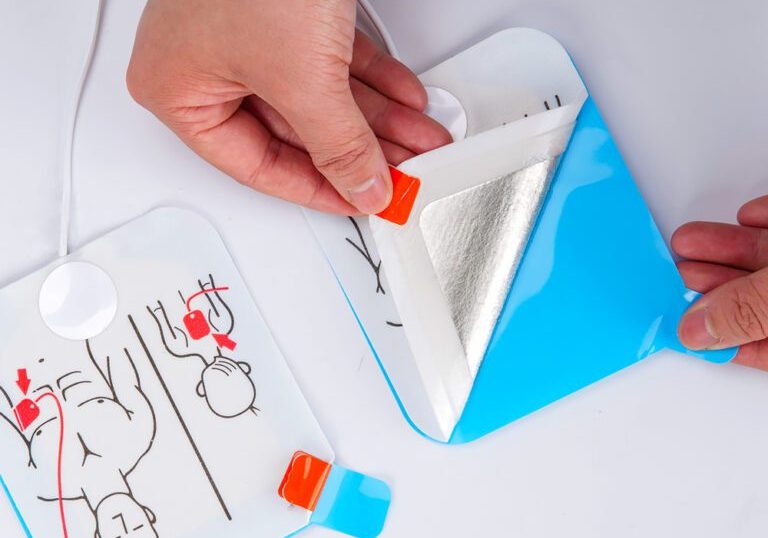
The 2025 RCUK guidelines state that the first pad (often marked with a picture on the packaging) should be placed on the upper right side of the chest, just below the collarbone, while the second pad should be placed on the lower left side of the chest, directly below the armpit. This is the recommended pad placement for adults.
Most automated external defibrillators (AEDs) have an image printed directly on the electrode pads that show where they should be placed on a person’s body.
The importance of defibrillator pad placement
Correct pad placement could make a life-saving difference. The heart sits deep within the chest cavity, so the pads must be positioned accurately to allow the electrical current to pass effectively through the heart.
Another important point is that defibrillator pads must be placed directly on bare skin.
This means any clothing that might interfere with the correct placement of the defibrillator pads must be removed, and that includes a bra. Pads should never be placed on top of clothing or fabric, even thin material, as this can reduce their effectiveness, If a bra interferes with pad placement or contains metal components such as underwiring, it should be removed.
But do note that a bra with underwiring or any other metal parts can prevent the pads making proper contact with the skin, and might even cause burns.
In a cardiac emergency, the first consideration must be saving someone’s life, but you could use a jacket or banket to preserve someone’s modesty after the pads are in place and resuscitation has begun.
Will defibrillator pads work on a hairy chest?
AED pads only work properly by sticking firmly to the skin, so it may be necessary to shave a hairy chest first. You’ll find a small disposable razor in most defibrillator kits, and need only shave a small area for pad placement. However, rescuers should avoid delaying defibrillation unnecessarily.
What if someone with a pacemaker has a cardiac arrest?
Their pacemaker may not be functioning correctly or may not be enough to restore a normal heart rhythm, so yes, you can still use a defibrillator. The RCUK’s 2025 guidance recommends placing the pads at least 8 centimetres away from the pacemaker site.
You can also use a defibrillator on a child
Many defibrillators have paediatric pads, or a child mode to lower the strength of the shock. For smaller children, one pad is usually placed on the front of the chest, and the other on the back between the shoulder blades, guided by the prompts on the pads.
Training from AEDdonate
Our Online CPR and AED Awareness Event gives you the practical knowledge and confidence to act quickly during a cardiac emergency.
The training session explains what to do in the critical first minutes before emergency services arrive, guiding you through recognising cardiac arrest, starting hands-only CPR, and using an automated external defibrillator (AED) safely and effectively.
The session is delivered live online and is accessible to individuals, community volunteers, schools, workplaces, and organisations responsible for public safety equipment.
While this event does not provide a formal first aid qualification, it equips you with essential awareness that could make a life-saving difference.